Publications
Recent Paper Highlight
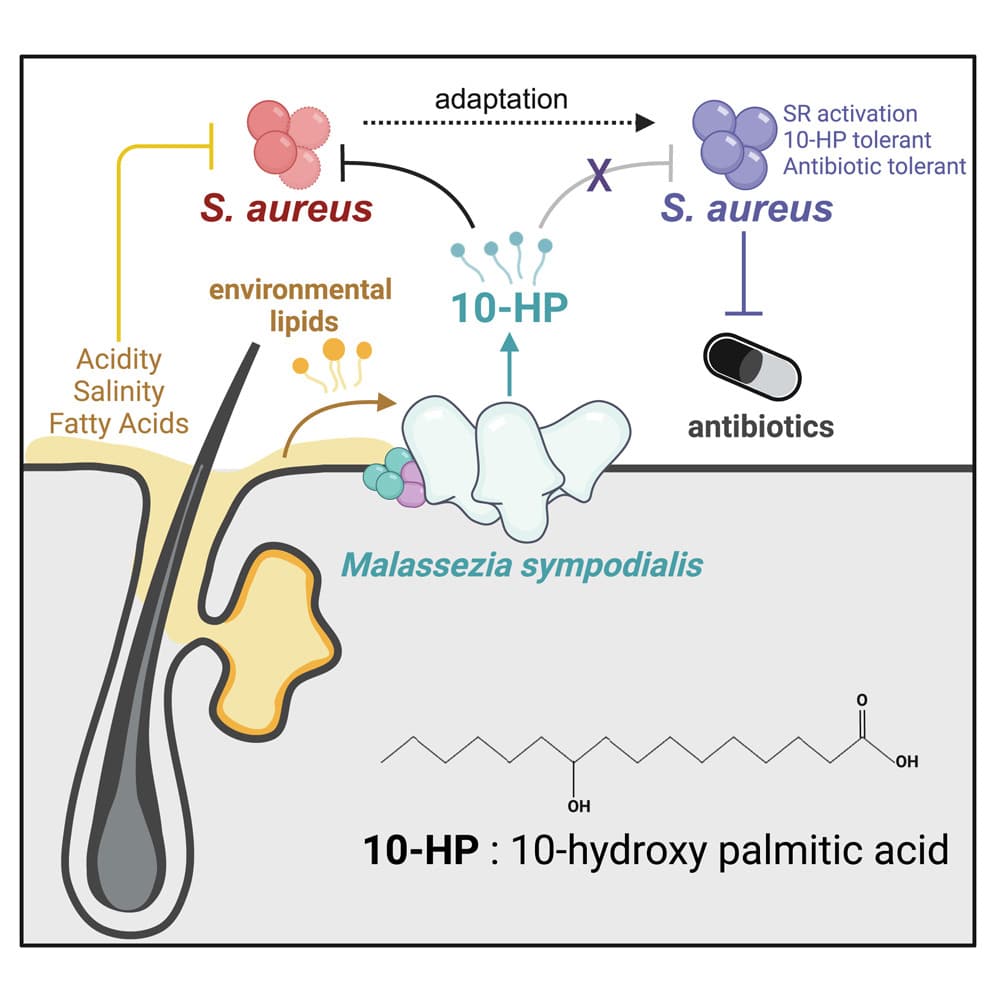
Skin mycobiota-mediated antagonism against Staphylococcus aureus through a modified fatty acid (Current Biology)
Malassezia are the dominant fungal genus on most skin sites and have adapted to colonize mammalian skin in the presence of other microbes. We hypothesized that Malassezia have evolved strategies to compete in polymicrobial communities and that these strategies could be leveraged to inhibit skin pathogens like S. aureus. We discovered that Malassezia can modify fatty acids in the environment to generate the antimicrobial hydroxy fatty acids, 10-hydroxy palmitic acid (10-HP) that can kill S. aureus specifically in skin-like conditions. Skin-resident staphylococci are less sensitive to 10-HP indicating they may have evolved to tolerate growth with Malassezia in the shared niche. Interestingly, S. aureus can evolved to tolerate 10-HP through mutations in the conserved stringent response regulator Rel that also allows S. aureus to survive exposure to antibiotics. Clinical strains have been reported that have similar mutations suggesting that some S. aureus isolates may be able to evade Malassezia antagonism on the skin.
This work will continue in the Kowalski Lab!
Selected Publications and Preprints
Kowalski CH, Nguyen UT, Lawhorn S, Smith TJ, Corrigan RM, Suh WS, Kalan L, Barber MF. Skin mycobiota-mediated antagonism against Staphylococcus aureus through a modified fatty acid. Current Biology. 2025. 35 (1): 2266-2281.e8. (co-corresponding author)
Kowalski CH, Khalil SB, James DA, Smith TJ, Campbell KD. Non-canonical stringent response signaling mediates antimicrobial fatty acid sensitivity in Staphylococcus aureus. bioRxiv. 2026. 02.01.703180; doi: https://doi.org/10.64898/2026.02.01.703180
Campbell K, Kowalski CH, Kohler KM, Kebret MR, Barber MF. Evolution of polyamine resistance in Staphylococcus aureus through modulation of potassium transport. mSphere. 2025 Aug 18:e0061324. doi: 10.1128/msphere.00613-24. Epub ahead of print. PMID: 40824070.
Kowalski CH, Morelli KA, Stajich JE, Nadell CD, Cramer RA. A Heterogeneously expressed gene family modulates the biofilm architecture and hypoxic growth of Aspergillus fumigatus. mBio. 2021 Feb 16;12(1):e03579-20.
Kowalski CH, Morelli KA, Schultz D, Nadell CD, Cramer RA. Fungal biofilm architecture produces hypoxic microenvironments that drive antifungal resistance. PNAS. 2020. 117 (36) 22473-22483
Kowalski CH, Cramer RA. If looks could kill: macroscopic morphology and fungal virulence. PLoS Pathogens Pearls. 2020. 16(6): e1008612.
Kowalski CH, Kerkaert JD, Liu KW, Bond MC, Hartmann R, Nadell CD, Stajich JE, Cramer RA. Fungal biofilm morphology impacts hypoxia fitness and disease progression. Nature Microbiology. 2019. 4, 2430–244.
Kowalski CH*, Beattie SR*, Fuller KK, McGurk EA, Tang YW, Hohl TM, et al. Heterogeneity among Isolates Reveals that Fitness in Low Oxygen Correlates with Aspergillus fumigatus Virulence. mBio. 2016;7(5).
 Kowalski Lab